Wednesday, 9 July 2014

Playing With Velver

Bredon Crafters has come round very soon after Quilting Arts so today I have worked hard preparing the project for next week.  At least now I am certain about what has to go into the kits and I will be with Kay and Chrys on Tuesday putting them together.

I first experienced this technique at a workshop with Angie Hughes and ever since have been promising myself another go using my own drawing rather than Angie's


To illustrate this post I will be using my own design and I have printed off enough for everyone.  However if you want to draw a design of your own it should be A4 size and drawn in such a way that it can be sliced into about five sections horizontally in a similar way to mine which you can see here.

Here the design is shown drawn on the paper side of Bondaweb and already sliced into sections on top of the black velvet..  You will see that I have cut a little more paper away in a couple of places because I want to use 'Hot Spots' there instead of Bondaweb.


Hot Spots are little pimples of glue on brown paper, rather than the glue mesh we are familiar with in Bondaweb.

This illustration shows them in close-up.  Hot Spots give a different result when foil is used so it adds variety to the picture.

In this illustration you can just see the iron at the side.  I am using it to tack the Bondaweb in place as I lie the strips on the black velvet and before ironing them in place fully.  This is to help get the image lined up properly with even gaps between the strips which outline and create the picture.


 Once the picture is ironed on to the velvet you can start working on it starting from the top.  Just remove the top paper only and work on that before moving to remove any more Bondaweb.

Always use baking parchment when gluing and decorating.  Cover the ironing pad with parchment and use a piece in between the iron and your work.

If you can remember the foiling we did way back you will soon be producing the first part of the picture.  Here though we are using Bondaweb and using a hot iron rather than waiting for glue to dry before applying the foils.

Always use foils COLOUR SIDE UP.

One colour on top of another gives interesting results and using second-hand foil is better than a brand new piece as the gaps in it make the work more natural.  When it is a completely new piece of foil the iron has to be used artistically to avoid big flat areas of colour and to keep away from the straight edges of the foil

I have used something called fusible film for the river, the moon and the church.  It has a shiny surface and does fuse to Bondaweb as well.


More to follow on all this bur for now here are some images of the partly finished and fully finished picture.

To be continued .....


Wednesday, 2 July 2014

Making a Placemat

I've written up the worksheet for making placemats. 

This placemat can be made up in numerous ways because the design has a plain centre which can be interpreted in any way you want.  It could have a patchwork or embroidered centre, fancy or formal quilting, applique, a painted surface, a photo on fabric or a block printed centre section. 

It occurs to me that this placemat design could be useful many times over so if we're stuck for a gift any time (or for exhibition items!!) we'll know what we can make.

However the purpose for it at the moment is as a vehicle for some block printing fun.  The sample I have made is block printed.  Not only does it provide an opportunity to practice some block printing but it's also a good way to try out some quilting or free machine embroidery techniques.  As well as that the mitred corners and the flat piping edging are useful techniques to practice too.


Here you see the flat piping machine-tacked in place before the borders are added.

Borders are sewn on right sides together, first at both sides, then top and bottom but starting the second lot of seams exactly at the corner so the mitred corners can be folded over as shown below.


So when the borders have been added the corners are mitred in a different way than we have previously done. 

The method is straightforward enough - just fold the top border under itself to form a 45 degree angle, make a crease and then with right sides together just sew along this crease from the corner to the edge.
This is all in the worksheet in detail.

Then the insulated wadding goes on the back with the metallised side up.

Any kind of decoration can be added at this point so long as it attaches the top to the wadding.  I have used free machine embroidery in metallic gold thread on the yellow lacy block print and green embroidery thread on the swirly flower block print.

 After this the lining is added, give it a good press and your placemat is finished.

Tuesday, 1 July 2014

We had a good one

The whole weekend was a success for Bredon Crafters and Quilting Arts.  Lots of visitors to the exhibition and the event enticing us to plan and present our own exhibition early next year.  What a beautiful display in the church, many, many congratulations to all those who planned, organised, created and presented the wonderful floral illustrations of well known books.

Thank you everyone, and most of all Chrys, who contributed to the design and making of Brian the Bredon Bookworm and also those who put him up on the church gate and then helped take him down again.  Let's hope Bredon Toddlers Group enjoy having him and that Brian enjoys his new home.

We need to get started again now so that we have lots of exciting exhibits ready for next year.  So the first thing for Quilting Arts is to try out some Indian Wood Block Printing on fabric which can then be used in various ways.  The project on offer for this is to make table placemats with the decorated material.

The printed blocks will decorate the centre of the placemat. Cut a piece of fabric for this centre piece measuring 16" X 10".

Gather together the fabric, your choice of print block, your choice of paint, a flat palette of some sort (a plastic plate will be available), a foam pad (use a mouse-mat if it has some give in it), a piece of sponge, some wet wipes and some kitchen paper.

Most of this will be available at our meeting - (but bring your own fabric)

 Put a small amount of paint on the palette, take up the sponge and twirl one corner of it in the paint so the paint spreads about and is not too thick on the sponge.

Transfer some of this paint on to the block with little tapping movements until all the pattern is covered.

Put the foam pad under the fabric centrally so that you can start printing from the centre.

Put the block face down on the fabric and apply pressure with the flat of your hand for a few seconds. Keep repeating this process as many times as you want and adding to the design on your cloth. Move the fabric as you work so that the foam pad is always underneath the printing area.

You will find that even if there is no paint left on the palette there will be quite a lot left in the sponge and tapping on the top of the block will transfer it to the pattern.

When you are finished with the first colour of paint it is time to clean everything up.  Your hands, the wood block the palette and the sponge.

Take it all to the sink and using one of the scrubbing brushes under running tepid water scrub the block clean and rinse out the sponge and palette till all paint is gone.  Dry with kitchen paper, squeeze the sponge in kitchen paper to prepare it for your next colour.  Use wet wipes for your hands and also to wipe off any paint traces from the foam mat under the fabric.

Now you are ready to add more to this design or start again with another one.

Here are some other example prints using 2 and 3 colours and which are ready to have some machine embroidery embellishment.

The method and worksheet for making up into placemats will follow.


Friday, 20 June 2014

Carry On Quilting

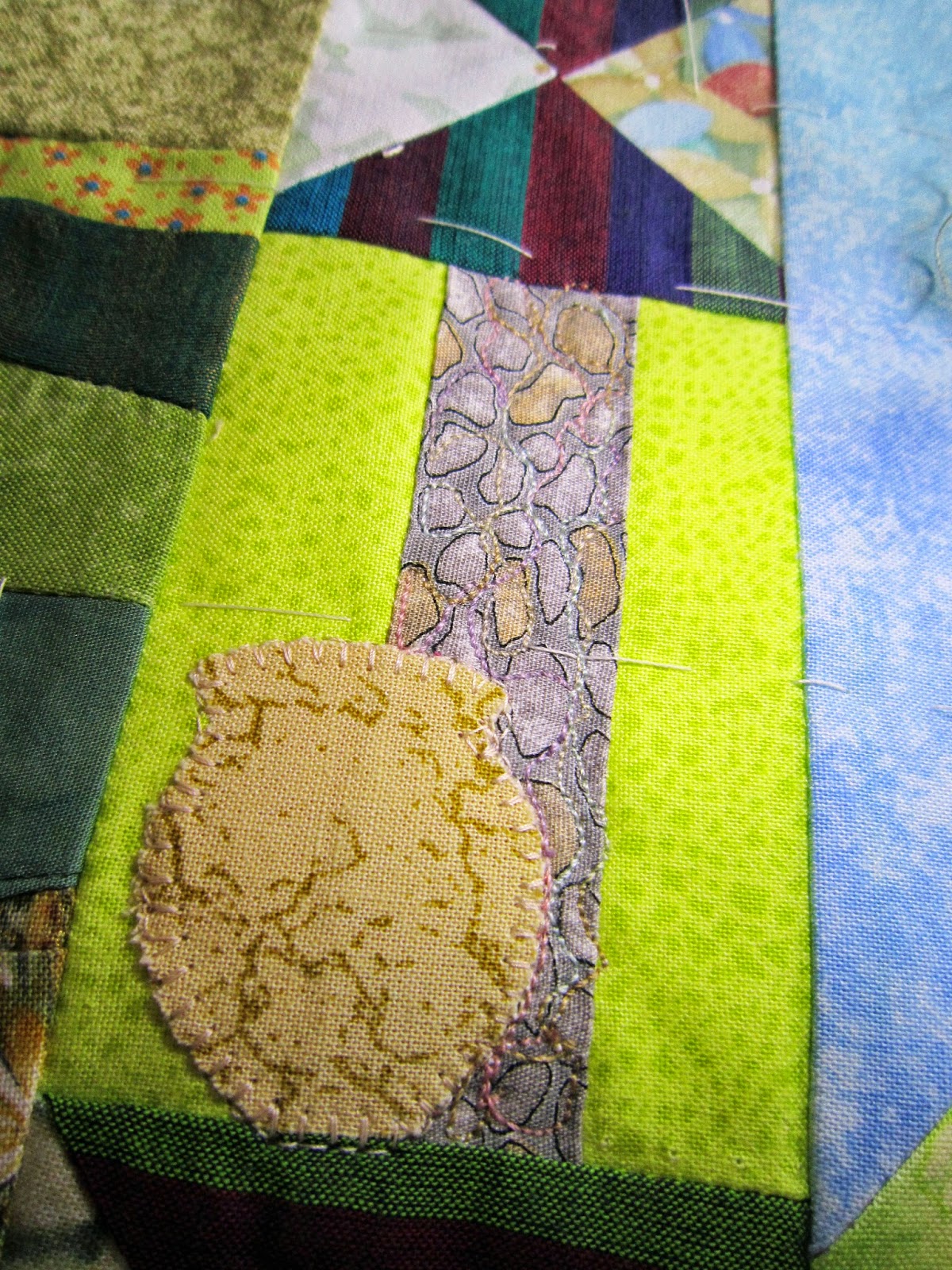
The second panel of my interpretation of the Scrap House Quilt is quilted.  I have used a variety of methods including free motion, normal machine stitching, fancy built-in stitches and some pieces left without any quilting at all.

It's hard work because the different areas of the quilt have their own character which needs to be echoed by the quilting.  So a lot of variety, imagination and innovation is needed.

But it's certainly not boring.  I don't think I could ever make a conventional quilt with the same patchwork repeated time and again all over it because to me that would be the pinnacle of boredom.

So the scrap house quilt idea is demanding in terms of having to think about it all the time and having to keep making decisions about what next.

It's very colourful.


One thing I have discovered about the house blocks, if you don't want to put masses of quilting on the house walls to keep them from bubbling, use some spray starch on them to make them nice and crisp.

This project is really good practice for machine embroidery, and trying out new stitched shapes is not too frightening because it all blends together and looks good even when not perfect. Using variegated quilting thread adds to the interest and enjoyment and also disguises less than perfect work.

So the third piece is now demanding attention.  I'm still not confident that I will get the quilt finished for the Flower Festival but that doesn't matter because its main purpose is to be an example and a learning curve for me and anyone else who wants to try making it,.

To be continued ...


Tuesday, 17 June 2014

Quilting the top

I don't seem to have got very far with the quilting!  I have finished one of the three sections, but it is the smallest one.  Lots of interruptions, phone calls, other stuff - that's my excuse anyway.

It takes a while because the nature of the design has lots of differing parts to it which means that I decided it needed a relevant type of quilting for each bit - not one design across the whole lot.

Of course it doesn't have to be done that way but having started it like that I have to continue.

Seeing it develop is fun though and most of all really good practice if you want to get better at free machine quilting.

Now I'm not confident that I will get it finished in time for the exhibition.

It's interesting to see the back of the quilting stitches because it is not confused by the fabric's print.  See image below. You can tell if your idea or plan has actually taken shape as you wanted it too - or not!  Another thing is that from the back you can see how your stitch tension is working out and adjust it if necessary.


One decision left to be made is what sort of border to put on it.  Because there is so much variety in the top itself I don't want to give myself a huge amount of work with the border - so it may be a plain one and perhaps one that matches the backing.
 Sections two and three are twice as wide as this one but whether that means twice as much work remains to be seen.

One thing - quilting it in sections is definitely an advantage over trying to do it all in one go on an ordinary domestic sewing machine.

If I reach the conclusion that I won't get it finished for the exhibition I shall put it on hold and pick it up again later.

To be continued .....

Sunday, 15 June 2014

Quilting The Top

The three sections of my Scrap House Quilt are ready and waiting to be quilted.  First there is some preparation to do as follows: 

Back the sections with wadding a little larger than the top (I have used more than I need here).


 On a flat surface smooth out the top on the wadding and tack the top in place.  Start from the middle and work outwards with a series of grids about 4" apart. 

 Select some cotton quilting thread in colours to blend or match your design.


 If you are machine quilting wind some bobbins in cotton thread - I am using white - and it's a good idea to wind a few so you don't have to stop once you get into the swing of things!

If free motion quilting set up the machine for that with the special foot, set stitch length to 0 and adjust your tension until the practice stitches look even on the back and the front.  Put the feed dogs down.  Ask for help if you want to practice some free motion quilting when we next meet.


 At this stage I am not putting a backing behind the wadding because I will have to join the three sections together and I want the backing to be in one piece - more on that later.

Prepare a practice piece with cotton and wadding pinned together.  Try out your stitches and have a go at the shapes you will use on the quilt.

Here you can see quilter's gloves in the picture.  These have rubbery dimples on the fingers and make moving the materials around much easier when doing free motion quilting.
  When you have tried out your planned stitching technique on the practice piece turn it over to see if the machine tension is ok.

Working with sections instead of the whole quilt obviously makes it easier to get the layers under the arm of the sewing machine.

Start quilting from the middle and work outwards.  You can roll up the sides or edges and pin with large safety pins.
 
An advantage with free motion quilting is you can work in whatever direction suits you so you can turn the work into the most advantageous position.
Now I am going to quilt this first section and then move on to the other two sections in the same way.

To be continued ....


Wednesday, 11 June 2014

Scrap House Quilt

Oh I'm so pleased the patchwork for the quilt is done.  It is in 3 sections ready to tackle the quilting next but I must tidy up first - bits of fabric everywhere and lots of patchwork pieces left over - I feel a mini project coming on!

In yesterday's blog I mentioned half square triangles and the multiple ways to use them in the Scrap House Quilt.  Also I have used quite a lot of curved pieces for gardens and landscape.

For a change I thought I would make some flying geese units in the way that Jane demonstrated to us at Quilting Arts last time so here are the photos.

Take one 2.5" X 4.5" rectangle in printed fabric and two 2.5" squares in plain fabric.

Fold the printed fabric in half across the 2.5" measurement.  Place this on top of a plain fabric square, folded edge at the top and 1/4" of plain showing above the fold.


 Place the second fabric square on top matching the raw edges.

With the folded edge still at the top pin and then sew the left hand edge with a scant 1/4" seam.


 Open out and press the printed fabric into a triangle as shown here.

When you have made several and want to sew them together use only a scant 1/4" seam so that you don't lose the points at the top (as you can see from the photo that is exactly what I did!)


When Jane demonstrated this technique she pointed out that the edges of the folds can be rolled and hand stitched down in the style of cathedral window quilting.  Mine shown here are just pinned in place not sewn down.


For my quilt I made a strip of these to fill the bottom corner.  They can just about be seen on the photo below.


So the next step is to put wadding and backing on the back of the three sections and do the quilting.  After that I will join them together and decide whether to add a border before binding and finishing.

Still a lot to do then!

To be continued ....